R1b Eo´ganacht septs


Home
Eoganacht History
Eoganacht Case Study
Family trees/branches
R-L21 Haplogroups
Name Variants
Trinity Study Results
Results
FAQs
Books
Contact Info

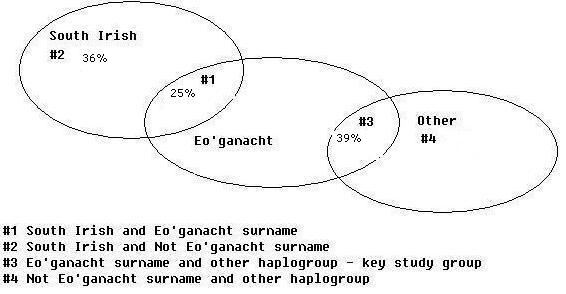
What is our project? Our study will include surname and modal haplotype research of those who:
1. Are South Irish modal haplotype and have Eoganacht surnames
2. Are South Irish modal haplotype and do not have Eoganacht surnames
identify cadet branches and move into group 1
3. Are not-South Irish modal haplotype and have Eoganacht surnames
identify modal haplotypes - are they indigenous or not indigenous to Southern Ireland
4. Are not-South Irish modal haplotype and do not have Eoganacht surnames
identify cadet branches and move into group 3

By some the Eoganacht are considered a pseudo family/political party rather than leaders who passed on their leadership role to their descendants creating a strong YDNA lineage as did the Irish I in the North of Ireland.  From my research this appears to fall within the range of my data and mirrors the conclusion found by the Trinity 2008 Study.  However, there is still much to be learned by studying the descendents of the Eoganacht for their modal haplotypes, SNPs and family history. 

Our goal is to better understand the Eoganachts septs, 500-1000A.D. by researching their descendents. 

Groups 1-3 are in the South Irish/Eoganacht septs research group.  Members in group 4 that have Eoganacht cadet branch names need to be identified and placed in group 3.

I am in the process of collaborating with Dr. Klyosov in writing a research paper to publish the results of our Case Studies on the Eoganachts:

My goal is to identify the YDNA of the Eoganachts.  The Eoganacht descendants in my FTDNA projects are approx. 50% South Irish modal haplotype and the rest being from indigenous and non-indigenous people.  I will build family trees and branches from clusters using Dr. Anatole Klyosov's mutation rate calculations.  I attach known available family histories to the YDNA family trees and branches.  The result should be very informative.

I credit Dr. Anatole Klyosov (mutation rate calculation methodology), Professor Donnchadh Ó Corráin (Professor Emeritus of Medieval History for help in building the historical background for the Eoganachts), Mike Walsh (FTDNA researcher uncovering modal haplotypes of the R-L21 now numbering 69 known and speculative groups), and Alex Williamson (who has helped answer questions so I understood Dr. Klyosov's work better).

My goal is to present my findings to others so they have a better understanding of the Eoganachts.

Kathleen Kerwin, administrator

We need volunteers to: (a team email will connect this group)

A. Coordinate and organize project member family histories
Dan Flynn, Kevin Michael Sullivan, Jack O'Keefe
Work product:
Take family histories and format them to include as comments
B. Research and organize Eoganacht surnames and history
 
Work product:
List Eoganacht sept, clan and cadet branches
Add all to FTDNA Eoganacht sept project list
Include in programming for results workbook
Build a Eoganacht sept, clan and cadet branch history
C. Develop family trees and branches, as well as lead others to building their own
Heather Ambler

Work product:

Using the Case Study Framework, build family trees and branches
Lead individual project members in building their family tree/branch

Eo'ganacht Yahoo Groups Forum - this is our communication forum which enables all to ask and answer questions.  Periodically the entries will be organized and summarized to build the knowledge database from which all members can draw background information.

Who is eligible to join

You do not have to be a member of a particular lab to join.  If you do not belong to FTDNA,please send me an email to receive your results.

Those who are not South Irish or a Eoganacht surname are welcome to join either of these projects to participate in the R-L21 modal haplotype analysis.  I currently analyze 69 R-L21 modal haplotypes.  The first three groups above automatically become part of the research group to build family trees and branches using the FTDNA Case Study Framework.  You can use our case study method using the tools built into a repeatable process; seehttp://eoganachtsepts.com/Case%20Studies.htm 

Haplogroup STR Analysis: We use str haplogroup analysis along with Deep Clade and SNP testing to determine a member's haplogroup.  STR haplogroup analysis is based on theory and may be used to predict Deep Clade or SNP grouping, however only Deep Clade or SNP testing can confirm a members haplogroup.  DNA results less than 67 markers are less accurate.  If you wish to improve the accuracy of your predictive results, upgrade to at least 67 markers.

Eo'ganacht Current Research Results: (sampling not random but based on project members) 12/16/2011 includes Eoganacht, South Irish, Sullivan and Mahoney projects.  Group 4 results are not included in the statistics since they are not in the research group.
1 Eoganacht/Dal Cais surname and Irish Type II          
     Chaisil - Sullivan   0.15 69    
     Chaisil - McCarthy   0.01 5    
     Chaisil - Dennehy   0.00 2    
     Chaisil - McGillicuddy   0.00 1    
     Chaisil - Sullivan MacCragh   0.00 1    
     Glendamnach - Keefe   0.00 2    
     Raithlind - O'Mahony   0.06 28    
     Raithlind - Connell   0.01 4    
     Raithlind - Donoghue   0.00 1    
     Raithlind - Hea   0.00 1    
     Raithlind - Lynch   0.00 1    
     Aine - O'Kirby   0.00 1    
        1 Subtotal   0.25 116    
2 Non Eoganacht/Dal Cais surname and Irish Type II          
        2 Subtotal   0.36 166 282  
3 Eoganacht/Dal Cais surname and Not Irish Type II          
     Chaisil - McCarthy     2    
               Unknown (GD > 9) (1) 0.00      
               L159_2 (1) 0.00      
     Chaisil - Sullivan     65    
               IrishI (3) 0.01      
               IrishIII (1) 0.00      
               Unknown (GD > 9) (50) 0.11      
               P314_2 (2) 0.00      
               L159_2 (3) 0.01      
               L513 (5) 0.01      
               ElyCarroll (1) 0.00      
     Chaisil - SullivanBarry     2    
               IrishIII (1) 0.00      
               Unknown (GD > 9) (1) 0.00      
     Chaisil - SullivanBowes     26    
               IrishI (1) 0.00      
               IrishIII (1) 0.00      
               Unknown (GD > 9) (16) 0.03      
               L513 (1) 0.00      
               ElyCarroll (7) 0.02      
     Chaisil - SullivanDoyle     1    
               590917 (1)        
     Chaisil/Raithlind - Callaghan     2    
               IrishI (1) 0.00      
               IrishIII (1) 0.00      
     Dal Cais - OBrien     1    
     Glendamnach - Keeffe     2    
               IrishIII (1) 0.00      
               ElyCarroll (1) 0.00      
     Raithlind - Connell     2    
               Unknown (GD > 9) (2) 0.00      
     Raithlind - Donoghue     4    
               IrishI (3) 0.01      
               Unknown (GD > 9) (1) 0.00      
     Raithlind - Flynn     3    
               Unknown (GD > 9) (3) 0.01      
     Raithlind - Hea     1    
               Unknown (GD > 9) (1) 0.00      
     Raithlind - Long     3    
               Unknown (GD > 9) (3) 0.01      
     Raithlind - O'Donnell     1    
     Raithlind - O'Neill     1    
               IrishI (1) 0.00      
     Raithlind - O'Mahony     64    
               IrishI (3) 0.01      
               IrishIII (8) 0.02      
               Other (1) 0.00      
               Unknown (GD > 9) (44) 0.09      
               P314_2 (2) 0.00      
               L159_2 (2) 0.00      
               590917 (3) 0      
               ElyCarroll (1) 0.00      
     Raithlind - Mongan     1    
               L513 (1) 0.00      
     Raithlind - Duggan     2    
               IrishI (1) 0.00      
               Unknown (GD > 9) (1) 0.00      
        3 Subtotal   0.39 183 183 465
4 Not Eoganacht/Dal Cais surname and Not Irish Type II          
     IrishI     9    
     IrishIII     10    
     IrishIV     2    
     L513     9    
     L371     0    
     L159_2     3    
     P314_2     4    
     Other      1    
     ClanColla     6    
     R_L21     0    
     Unknown (GD > 9)     211    
        4 Subtotal     262    

Surnames in the Eoganacht sept project include (see clans)

  • Eoganacht Chaisil -
    • MacCarthy, O'Sullivan, plus later O'Dennehy, MacGillicudy, O'Callaghan, MacAuliffe
  • Eoganacht Locha Lein - O'Moriarty
  • Eoganacht Raithlind -
    • O'Mahoney, O'Donoghue, O'Long, O'Neill, O'Duggan, O'Feehan, O'Donnell, Mongan, O'Connell, Lynch, O'Hea, O'Cohalane/O'Coughlan, O'Cannifree, O'Bogue, Cahalane, O'Cronin, O'Flahiffe, O'Flynn, Connelly, O'Callaghan
  • Eoganacht Glendamnach - O'Keefe
  • Eoganacht Aine - O'Kirby
  • Eoganacht Arann (a.k.a. Ninussa) - extinct
  • Eoganacht Ruis Argait - extinct
  • Dal Cais - OBrien, Kennedy (not of the Eoganacht sept, however many members are closely related to the Eoganacht sept)

The clan names are well-known and relatively easy to categorize.  The cadet branch names, based on nicknames due to the large number of individuals in a clan trying to differentiate themselves, are more obscure and will be a challenge to identify.

Eoganacht Sept Project: Considering the Trinity Study in 2008, I noticed that they used STR's to find out who the Eoganacht's may have been based on their DNA.  I believe the reason they couldn't come to a conclusion is precisely that they used STRs and did not identify the haplogroups of the test donors.  The documentation of the study (history of the Eoganachts) described their ancestry but the testing of the STRs reflected the current STR values of the test subjects.  A closer alignment would be to use deep ancestry DNA analysis (haplogroup analysis of the individual STR tests) to the deep ancestry goals of the 2008 Trinity Study; i.e. studying the deep ancestry of the Eoganachts.
 
I believe that by identifying the haplogroups of the test donors (see workbook columns AZ and BA, Best Match L-21 Project and Closest Match respectively) the study would have found the MRCA of the test donors which would have identified their ancestry.  This is the foundation of my study of the Eoganachts.  The study will eventually include those in the Normal Curve that are South Irish, possibly those that are Irish Type III, and those whose haplogroups may have been in the area prior to the time of the Eoganachts.  Those outside the Normal Curve will be explained before being eliminated or rethought as to belonging to the Eoganachts.

South Irish

  • 1 Eoganacht/Dal Cais surname and Irish Type II - as expected
  • 2 Not Eoganacht/Dal Cais surname and Irish Type II - as expected
    • Future study - those without Eo'ganacht surnames South Irish
      • These families:
        • lived in the area before surnames (before 1000-1000 AD)
        • they are South Irish but descended from different groups other than Eo'ganacht
          • study family histories
            • what is the cultural history their ancestors belong?
            • what region do their family history state they belong?
            • what timeframe do their family histories include?
        • they are South Irish but their surnames were changed to their mother's maiden surname in order to inherit property from their mother

Not South Irish

  • 3 Eoganacht/Dal Cais surname and not Irish Type II
    • Those who are Eo'ganacht surnamed and South Irish fit the accepted pattern.  Those who are Eo'ganacht surnamed and have a non-South Irish haplogroup should be studied for how these haplogroups are related to the South Irish and the region in time and markers.
      • Those with Eo'ganacht surnames but Not South Irish
        • These families:
          • lived in the area before surnames (before 1000-1000 AD) and adopted Eo'ganacht surnames or
          • migrated to southern Ireland and later adopted Eo'ganacht surnames
          • they are not South Irish but their surnames were changed to their mother's Eoganacht maiden surname in order to inherit property from their mother
      • Haplogroups study
        • what if the original region of these haplogroups?
          • did they migrate to southern Ireland and change their names to Eo'ganacht surnames?
          • were they originally from southern Ireland?
        • what is their calculated date range?
          • did these haplogroups exist before the South Irish date range and before surnames and therefore exist in the region contemporary to the South Irish?
        • how do their markers compare to the South Irish?
  • 4 Not Eoganacht/Dal Cais surname and Not Irish Type II

How to confirm clans and septs? By testing the DNA of known Eoganacht Clan members either individually or through research projects. 

  • At least 3 results for known surname members, not closely related, will be used as the target baseline for the surname clan.  This will be a moving target as our testing becomes more refined.
  • The results above will then be compared to their closest matches of the research group common ancestors.

What does this study do for you? If you have a surname listed above, you may be able to match your DNA results with baseline results from known surname clan members and your most common ancestor.  By finding your Eoganacht Clan name, you may be able to trace your family history by learning more about that particular Clan. This knowledge may lead to your knowing more about the general area your family came from in Ireland.

Who does this effect? Knowing which clan you belong to directly effects those with the surname or a variant name of the Eoganacht Clan (such as cadet branches).  For non-Eoganacht surnames the family relationship may go back to before family surnames were used in Ireland; before 900 - 1100 AD.  If you have a Eoganacht surname in your genetic distance matches, our study may be of interest to you.


What's  New

  • ...
  • ...


Key Milestones


R1b Eo´ganacht septs Project © 2010
For problems or questions regarding this Web site contact Webmaster
Last updated: 05/10/12